

Most GxP labs today operate ELNs, LIMS, and QMS. Documentation is digital, audit trails exist, and compliance frameworks are well established.
Yet during audits and daily lab work, one uncomfortable truth repeatedly surfaces:
Most GxP labs are digitally documented — but not digitally executed.
Between written procedures and generated results, a critical gap remains.
This is the Execution Gap.
Executive Summary
Regulated laboratories have invested heavily in digital systems such as ELN, LIMS, and QMS. Documentation is digital, audit trails exist, and compliance frameworks are well established.
However, the most critical part of laboratory work still happens outside these systems: workflow execution at the bench.
This gap between documented procedures and real-world execution creates hidden compliance risks, inefficiencies, and data integrity challenges.
In this article, we explore:
- Why ELN and LIMS cannot ensure compliant workflow execution
- Where manual processes introduce risk in GxP environments
- What true digital workflow execution looks like
- Why a dedicated execution layer is becoming essential for audit readiness, scalability, and AI-driven laboratories
Closing the execution gap is the next step in the digital transformation of regulated labs.
What is Changing in the Lab
Regulated laboratories are undergoing rapid transformation.
Data volumes are growing, regulatory expectations are increasing, and organizations are expected to deliver results faster while maintaining full compliance.
Several trends are reshaping daily lab work:
- Digital lab ecosystems – ELN, LIMS and QMS are now widely adopted, replacing many paper-based processes.
- Connected instruments – Labs operate more devices than ever, generating increasing amounts of data.
- Stronger focus on data integrity – Regulators are placing greater scrutiny on traceability and audit readiness.
- Global collaboration – Workflows must be standardized and scalable across sites.
- AI and advanced analytics – New technologies require structured, contextual, and trustworthy data.
While documentation and data storage have become digital, workflow execution at the bench has not kept pace.
This shift is bringing the execution gap into focus.
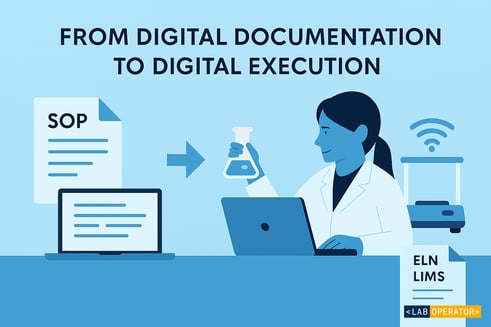
The Real Problem: Digital Documentation Without Digital Execution
Despite major investments in digital lab systems, a critical part of laboratory work remains largely manual.
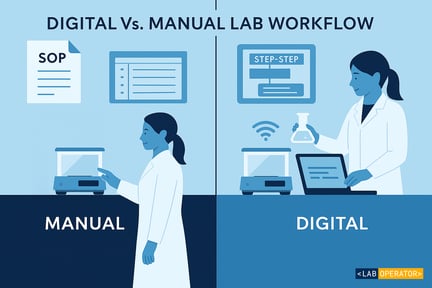
Most GxP labs today operate electronic systems for:
- SOP management
- Documentation and reporting
- Sample and batch tracking
- Quality and compliance processes
From a systems perspective, the lab appears highly digital.
But when scientists perform their daily work at the bench, the reality often looks very different.
They still rely on:
- PDF or printed SOPs
- Manual step execution
- Local instrument software
- Excel templates and calculators
- Copy-paste data transfer between systems
This creates a disconnect between how work is documented and how work is actually performed.
Procedures are digital.
Results are digital.
But the execution in between is not.
This is the root cause of the Execution Gap in regulated laboratories.
Key Concepts
Before diving deeper, it is helpful to clarify three core concepts that shape digital laboratory environments.
Digital Documentation
Systems such as ELN, LIMS, and QMS focus on storing, managing, and reviewing information.
They capture:
- Experimental results
- Sample and batch information
- SOPs and quality documentation
These systems ensure traceability of what was documented.
Workflow Execution
Workflow execution describes the actual performance of laboratory procedures at the bench.
This includes:
- Step-by-step guidance for scientists
- Interaction with laboratory instruments
- Real-time capture of data and metadata
Execution focuses on how work is performed.
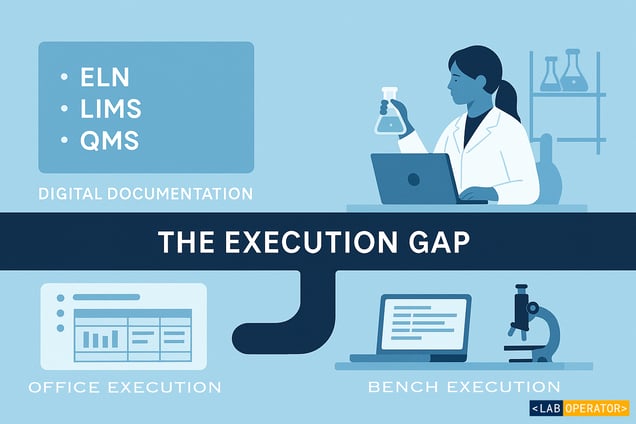
The Execution Gap
The execution gap is the space between documented procedures and documented results.
When workflows are executed manually and documented afterward, risks arise:
- Transcription errors
- Missing metadata
- Inconsistent execution
- Complex audit preparation
Closing this gap requires bringing workflow execution into the digital ecosystem.
Introducing the Execution Layer
A modern lab operating model adds a dedicated execution layer between planning and documentation.
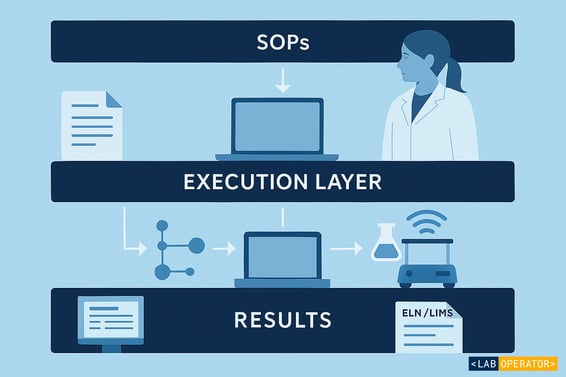 This layer connects:
- Scientists
- Instruments
- Workflows
- Enterprise lab (office) systems, e.g. ELN or LIMS
It ensures that workflows are:
- Guided during execution
- Connected to instruments
- Captured in real time
- Fully traceable by design
With this layer in place, the lab architecture becomes complete — linking SOPs, execution, and results into a continuous digital process.
How It Works: Step by Step Workflow Execution in a GxP
Environment
A compliant execution model connects SOPs, instruments, scientists, and enterprise systems into one controlled flow. Here is what that looks like step by step:
1. Workflow is defined and approved
The procedure is created and approved in the QMS (e.g., SOP, method, or work instruction).
A validated workflow template is then made available for execution — including required steps, data fields, and checks.
2. Work is planned and assigned
Samples, batches, and work orders are managed in LIMS (or a planning system).
The workflow is linked to:
- the correct sample IDs / batch context
- required materials and instruments
- roles and permissions (who can execute, review, approve)
3. Scientist starts execution at the bench
The user launches the workflow in the execution layer (LES).
Key controls are enforced automatically:
- correct user authentication and role-based access
- training status / authorization checks (if required)
- version control (ensuring the approved workflow version is used)
4. Guided steps reduce variability
The workflow guides the scientist step-by-step.
Each step can require:
- confirmations and checks
- calibration and expiration checks
- required fields
- thresholds / pass-fail criteria
- conditional branching (e.g., “if out-of-range → retest / deviation flow”)
This minimizes interpretation and ensures consistent execution.
5. Instruments are connected and data is captured automatically
Connected bench-top instruments stream results directly into the workflow record.
This typically includes:
- measurement values
- timestamps
- instrument ID and configuration
- relevant metadata
This eliminates transcription and strengthens data integrity.
6. Built-in audit trail is created during execution
Every action is logged automatically:
- who did what
- when it happened
- what data was generated
- which instrument was used
- which workflow version was executed
Audit trails are generated as a by-product of work, not reconstructed afterward.
7. Exceptions follow controlled paths
If something goes wrong (out-of-spec values, missing data, instrument issues), the workflow can enforce:
- repeat steps
- escalation and approvals
- deviation / investigation triggers
- mandatory comments and attachments
This makes exceptions manageable and compliant — without relying on memory or side notes.
8. Review and approval becomes faster and more robust
Because data and context are already structured, review becomes significantly easier:
- completeness checks are automatic
- reviewers can see the full execution context
- approvals are traceable and attributable
9. Results are handed over to ELN/LIMS and reporting systems
Final results and required metadata are transferred to:
- ELN (documentation and scientific narrative)
- LIMS (sample lifecycle, batch record, status updates)
- analytics/data platforms (dashboards, trending, AI)
This closes the loop from SOP → execution → results — with full traceability.
Compliance, Risk, and Business Value
Closing the execution gap is not only a technology improvement — it directly impacts compliance, operational risk, and laboratory performance.
Stronger Data Integrity by Design
In manual environments, compliance is often achieved through training, documentation, and retrospective checks.
With digital workflow execution, compliance becomes part of the process itself.
Key improvements include:
- Automatic capture of timestamps, users, and instrument data
- Elimination of manual transcription and copy-paste steps
- Enforced use of approved workflow versions
- Consistent execution across users and sites
Instead of reconstructing the story of an experiment during an audit, the full execution history already exists.
 Reduced Compliance Risk
Many common GxP findings originate from the same root causes:
- Incomplete records
- Missing metadata
- Inconsistent execution
- Uncontrolled spreadsheets
- Unclear audit trails
A digital execution layer addresses these risks at their source.
It ensures that:
- Required fields cannot be skipped
- Deviations follow controlled processes
- Data is captured contemporaneously
- Audit trails are generated automatically
This shifts compliance from reactive to proactive.
Faster and Less Stressful Audits
Audit preparation often requires weeks of effort:
- Collecting documentation
- Reconstructing workflows
- Explaining manual processes
- Verifying data consistency across systems
With digital execution, much of this work disappears.
Auditors can see:
- how workflows are executed
- which controls are enforced
- how data flows between systems
- how traceability is ensured
Audit readiness becomes part of daily operations rather than a periodic project.
Efficiency Gains for Lab Teams
Scientists should focus on science — not data transcription and paperwork.
Digital workflow execution reduces:
- manual data transfer
- repetitive documentation work
- time spent searching for missing information
- rework caused by human error
This allows laboratory teams to:
- increase throughput
- improve consistency
- focus on high-value activities
A Scalable Foundation for the Future
As labs grow, collaborate globally, and adopt AI-driven analytics, the need for structured and trustworthy data becomes critical.
A digital execution layer provides:
- standardized workflows across sites
- consistent data generation
- reliable context and meaning for analytics and AI
- a scalable foundation for future automation
Compliance, efficiency, and innovation no longer compete — they reinforce each other.
Conclusion: From Digital Documentation to Digital Execution
Regulated laboratories have made enormous progress in digitalization.
Documentation, quality processes, and sample management are now largely digital and well established.
But the most critical step — the execution of laboratory workflows — still often happens outside the digital ecosystem.
This execution gap introduces compliance risks, limits scalability, and consumes valuable scientific time with manual tasks.
The next phase of laboratory digital transformation is clear:
bringing workflow execution into the digital architecture.
By connecting SOPs, scientists, instruments, and enterprise systems in one continuous flow, laboratories can move from retrospective documentation toward real-time, audit-ready execution.
The result is a lab that is:
- more compliant
- more efficient
- more scalable
- better prepared for AI and advanced analytics
The future of GxP laboratories is not just digital documentation.
It is digital execution.
Close the Execution Gap in Your Lab
A Lab Execution System provides the missing execution layer that connects workflows, instruments, and enterprise lab systems into one controlled environment.
If you want to explore how audit-ready workflow execution can look in your organization, our team is happy to help.
Talk to an expert and discover how to close the execution gap in your laboratory.