

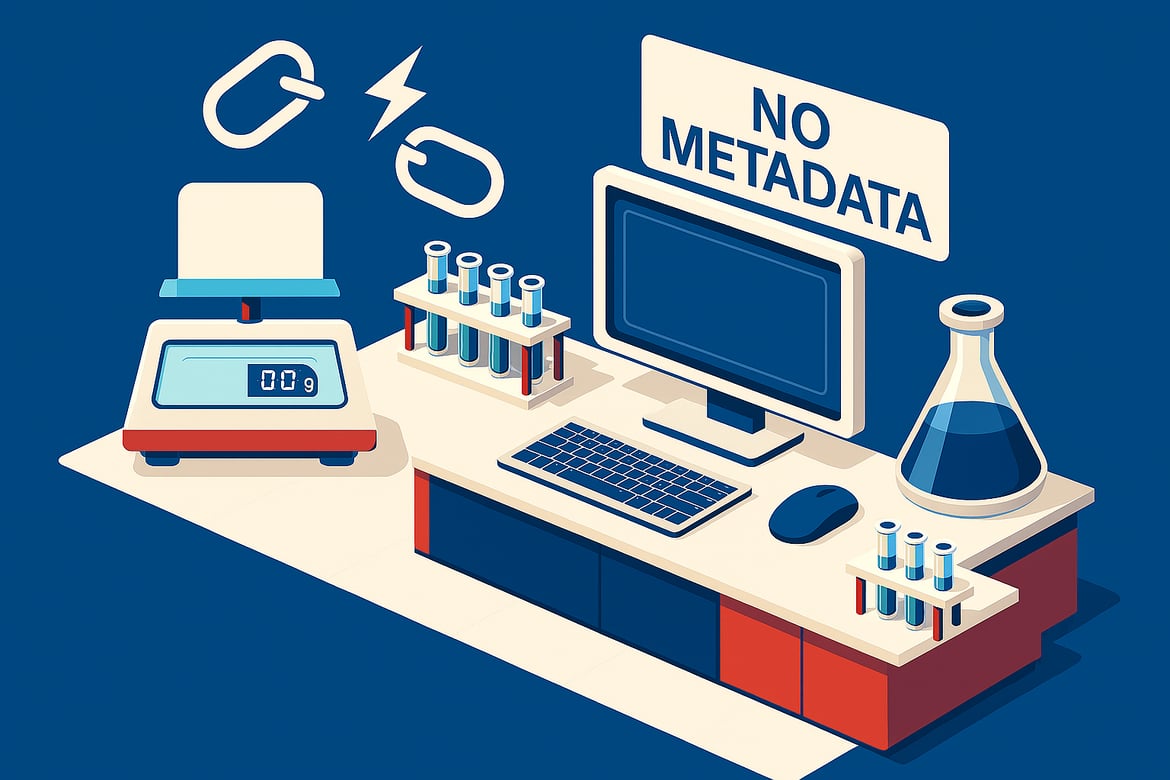
For years, laboratories have focused on capturing accurate measurements: a mass reading, a pH value, a chromatogram, a temperature log. But as labs move toward automation, advanced analytics, and AI‑driven decision‑making, one truth is becoming impossible to ignore:
A number alone is not enough.
A measurement without context cannot be used reliably by software, automation systems, or machine intelligence. And in today’s regulated and increasingly data‑driven environments, context is everything.
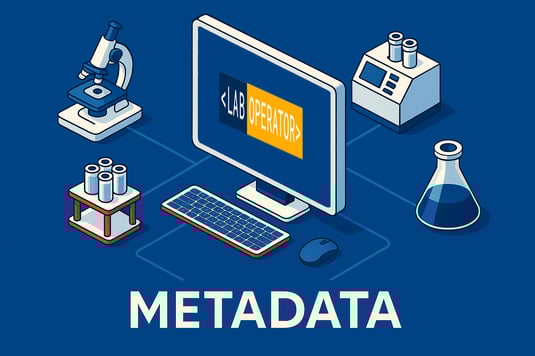
The next frontier for the modern digital lab is not just collecting data—it’s enriching it with metadata. And the deeper that metadata stack becomes, the more intelligent, compliant, and connected the laboratory becomes.
From Raw Readings to Actionable Information
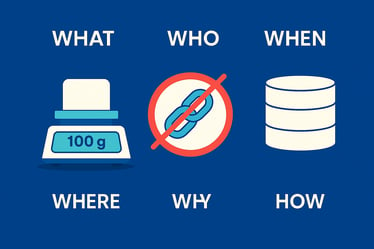
Consider a simple value: 100 g.
Is that an API? A buffer? A reagent? The tare of a container? Was the balance calibrated? Who performed it? Under which method? Which sample ID does it belong to? What was the temperature or humidity during the measurement?
Without answers to these questions, the number is just… a number. It has no meaning to a human—or to an AI model.
With metadata, that same number becomes part of a structured, interoperable dataset. It becomes usable knowledge.
Metadata layers provide context such as:
- WHAT was measured (sample, test method, experiment)
- WHO performed the action (user identity, authorization)
- WHEN it happened (timestamp, sequence)
- WHERE it took place (device, lab environment)
- WHY it took place (research, qa/qc, contract testing)
- HOW the measurement was produced (configuration, calibration, method parameters)
This contextualization transforms isolated readings into a rich information graph that automation systems can navigate and AI can interpret.
A Foundation for Data Integrity and Compliance
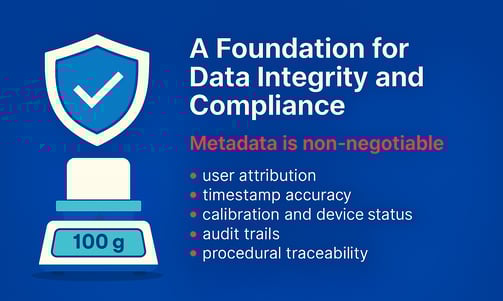
In regulated environments, metadata moves from “valuable” to non‑negotiable.
Frameworks such as ALCOA+, 21 CFR Part 11, and EU Annex 11 require:
- user attribution
- timestamp accuracy
- calibration and device status
- audit trails
- procedural traceability
Metadata provides all of this automatically.
The absence of metadata forces labs back into manual transcription, handwritten notes, and error‑prone processes—leading to compliance gaps, audit findings, and data integrity risks.
Simply put:
Without metadata, there is no compliant digital record.
As a CPO, I see metadata as the real connective tissue of the modern laboratory. Instruments, software, and AI systems can only deliver their full potential when every data point carries the context that gives it meaning. The future of the AI‑enabled lab won’t be defined by faster measurements, but by the richness of the metadata that surrounds them—and by the platforms that make that context usable, trustworthy, and universally connected.
Unlocking Automation Across Devices, Workflows, and Systems
Automation relies on context to make decisions. A system cannot trigger the next workflow step unless it knows:
- which sample the measurement belongs to
- whether the device was in a valid state
- which method was executed
- whether the reading meets defined thresholds
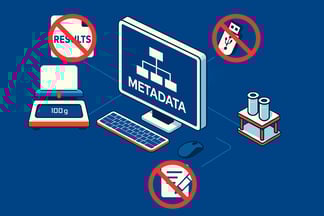 When labs connect instruments, software, and workflows through a shared metadata layer, something powerful happens:
automation becomes reliable, scalable, and repeatable.
Metadata acts as the glue that links:
-
-
- - analytical equipment
- - balances and preparation devices
- - LIMS, ELN, LES, MES, and other software systems
- - digital SOPs and automated workflows
-
With these connections in place, documentation becomes automated, calculations become consistent, and data flows freely between systems—without USB sticks, file uploads, or handwritten notes.
Powering Predictive Insights and AI‑Enabled Optimization
 The future of the lab is proactive.
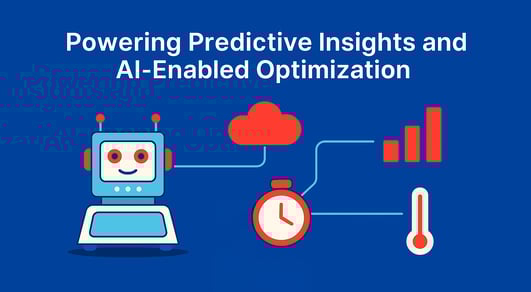
Predictive maintenance, intelligent scheduling, automated QC release, and real‑time optimization only become possible when labs capture not just measurement data, but also:
- usage hours
- throughput
- device health indicators
- environmental parameters
- historical performance patterns
This ecosystem metadata feeds machine learning models that can anticipate failures, optimize utilization, or simulate operations through digital twins.
What emerges is an AI‑ready laboratory—one capable of learning from itself.
Metadata: The Engine Behind the Modern Laboratory
Metadata is no longer a backend detail. It has become a strategic capability—one that determines whether a lab can:
- automate complex workflows
- meet compliance requirements
- standardize global operations
- integrate heterogeneous devices and software
- unlock the true potential of AI
In a world where labs generate more data than ever before, the question is no longer whether to collect metadata—but how fast you can put it to work.
The laboratories that invest in rich, connected metadata today will be the ones that achieve the highest levels of efficiency, reliability, scalability, and innovation tomorrow.
Conclusion:
Metadata is no longer a technical detail—it is the engine that powers the modern laboratory. By giving every data point the context it needs to travel across systems, trigger workflows, and inform AI, metadata turns isolated measurements into actionable knowledge. Laboratories that embrace this shift today will be the ones that automate with confidence, innovate at scale, and lead the industry into an AI‑enabled future. Check out Laboperator to understand how metadata will support your lab!